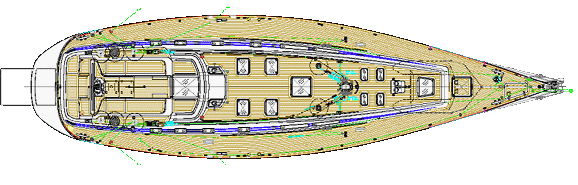
THE BOAT:
A Swan 56, commissioned in Finland, May 2003
The Builder:
Nautor's Swan of Jackobstad (Pietarsaari), Finland. Nautor has been building
sailboats for over 30 years in northern Finland (170 miles south of the artic circle!). In the late
1990's the company was purchased by the Ferragamo Family of Italy and since then has
dramatically expanded its line of boats. The full line of boats offered today is 45, 48, 56, 60,
70, 82, 100, 112 feet. We chose a Swan for their reputation as a rock solid, strong, blue-water
boat that was also fairly fast and fun to sail. The fact that the boats are production boats,
rather than custom, gave us confidence that many of the bugs of would have been worked out; we are
hull number 34 of the 56 model.
Specs:
| Length overall: |
57.5 feet |
Length on Water Line: |
49.5 feet |
| Beam: |
15.5 feet |
Draft: |
9.0 feet |
| Mast height: |
78.7 feet |
Displacement: |
24 tons |
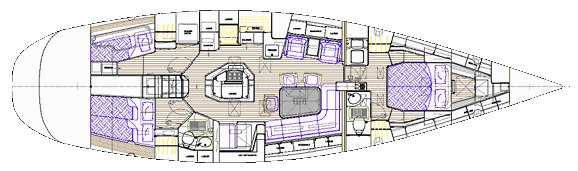
Cabins/sleeping accommodations: 8 people
Owners cabin forward with centerline queen bed, separate stall shower and head
Aft starboard cabin with double bed and head
Aft port cabin with bunk beds, washing/drying machine, and wet locker
Main saloon: stowaway pipe berth & settee berth
Sail Areas (sq feet):
| Main |
845 sq ft |
Asymmetrical Spinnaker: |
1,869 sq ft |
| Jib (135%) |
1030 sq ft |
Jib (105%) |
777 sq ft |
| Staysail |
391 sq ft |
Storm Try sail |
255 sq ft |
All sails were designed by Scott Zebny of North Sails, Ft. Lauderdale (w) (Scott specializes in
cruising sails and has built sails for some big boats including the two largest sloops in the world:
Georgia and Jim Clark's Hyperion. His current project is the remake of last of the Americas
Cup “J” boats: Ranger). Our mainsail and jibs are Marathon 3DL sails, the staysail is
Spectra.
The mainsail is attached to a boom-furling system patented by Leisure Furl of New Zealand and
constructed by Offshore Spars. Unlike mast furling systems, this permits a well-shaped, full draft,
and full batten sail that performs as well as a conventional main sail, but is easy and convenient
for two people to hoist, reef, and stow. The jib is on a Reckman hydraulic furling unit that is
very reliable and maintenance free. The staysail is on a conventional Reckman manual furling unit.
Engine & Generator:
Yanmar 4JH-UTBE: 100 horsepower, (drives boat at 8.5 – 9.0 knots)
Westerbeke AC electrical generator: 5.7 kW (provides 25 amps of 220 volt power to simultaneously
cool the fridge/freezer, heat the hot water, and charge the batteries. If we want to use the
washing & drying machine we need to turn off something)
Fuel:
4 x 55 gallon tanks = 224 gallons of diesel. This is sufficient to allow us to motor about
700 miles @ 8.0 knots. Hopefully this will get us through the doldrums and other areas of low wind
quickly.
Water:
Tankage: 2 x 55 gallon tanks = 110 gallons of water. We go through this amount in 3 to 4 days if we
are showering and doing dishes in fresh water (the electric heads also use fresh water).
Watermaker: Spectra 400 this will make up to 400 gallons of freshwater from sea water per day.
This runs off of DC power (using about 10 amps) and is fairly quiet; we tend to run it 3 to 4 hours
per day while we are sailing. We also can get fresh water at marinas, at least in Europe.
Batteries:
| Service batteries: 24 volt, 540 amp-hours |
Starter batteries: 12 volt |
| Instrument buffer batteries: 12 V 25 Ah |
Bow thruster batteries: 24 volt |
Most of Apsara's electrically-powered equipment requires DC power with the biggest consumers
being the autopilot, the navigation systems, the communication systems, the watermaker, and
lights/stereo. Other equipment requires AC power. If these do not require too much power (e.g.
computer, microwave, printer, etc) they can be run via an inverter which converts DC power to AC
power; otherwise they require running the generator which makes AC power to run the battery
chargers, the refrigerator, the water heater, and the washing/drying machine. We can also charge
the batteries, cool the fridge and heat water with the engine, thus we have a back-up system if we
have a problem with the generator.
Electronics:
| 2 Raymarine radar/chartplotters (10" display on deck and 7" at
nav station) |
2 built in GPS (3 spare handhelds) |
| Iridium satellite phone for voice and e-mail |
Icom M802 single-side-band radio |
| Computer nav software: Nobeltech & C-map charts |
Icom M502 VHF radio (nav & cockpit) Standard Horizon VHF in cockpit |
| CARD - collision avoidance radar detector system.
Basically a radar detector that tells us if a ship is near
(at least if it is using radar - most do, we hope) |
Interphase Forward looking sonar - this is a depth
finder that looks ahead and is suppose to help us not run aground. (When we run aground this is what we will blame
our mistake on.) |
| OCENS weather satellite receiver - this hardware and computer
based software allow us to down-load weather
satellite images. |
2 IBM Laptops (1 at the nav station dedicated to navigation and
communication, and
1 backup that is used for everything else) |
Email Communications:
Our e-mail systems were designed by Dan Piltch of Marine Computer Systems in Portland, Maine. We
are using MarineNet email software, which allows us to send and receive e-mail from sea via the
Iridium satellite phone or the Single Side Band Radio. Thus far, we mostly us the 4.2 kb satellite
system which costs about $1.50/minute. A typical email call is 3-4 minutes and lets us send or
receive about 7-10 messages in a text only format. Connections have been some what erratic so far
and we typically need to re-connect once for every two calls attempted.
Other:
| Electric winches (mostly) |
Reckman hydraulic furling headsail |
| Leisure furl manual boom furling mainsail |
Lewmar electric windlass |
| Max Power Bowthruster |
NKE autopilot (the pilot of single-handed round-the-world sailors) |
| Miel combo washing machine/dryer (230 volt, 50 Hz) |
26,000 BTU air conditioning system |
| Cabin heaters - Eberspacher (diesel) |
|
What has not worked (so far):
- Spectra watermaker – this currently has a problem
with some sensors that detect when the
filters are ready to be changed, but we can run the system and have been making water. We expect
to have this fixed soon. Company support has been good.
- Bowthruster – very reliable for first 6 weeks then it
malfunctioned, nearly causing a
collision. Still, we like the unit and expect that once the electrical bug is fixed, it will earn
our trust again. The Swan 56 has only a few inches of draft forward of the mast in the water,
which makes the boat faster, but the bow is quickly blown sideways in docking situations, the bow
thruster allows us to control the bow easily.
- Water pump – one pump has failed but we have a back-up in
line pump and so we have not been
inconvenienced.
Otherwise, the boat, despite its complexity has been fairly trouble free and
the systems have worked
as well or better than expected. One of the most critical systems, the Leisure Furl boom-furling
mainsail, has worked better than expected and we are pleased with our choice. Much of the credit
for this system goes to the sailmaker designing the right sail and fitting it properly. The other
pleasant surprise has been the Miele washer/dryer unit which while being small and somewhat slow,
does its job well and gets the clothes clean and dry.
See also the Buying Apsara page.
THE COUNTRIES:
THE WEATHER:
Here's a link to a UK sailing weather site at
Weather Online
|